Categories
peripheral aneurysm

Popliteal Artery Aneurysm Sac Growth From Endoleak After Bypass

PAA figure 1

AUGUST 5, 2008 9:59 PM

The femoro-popliteal aneurysm originally ruptured four years prior to surgery and I had bypassed it with a PTFE graft. For the trainees, I have to emphasize that these aneurysms rarely rupture, and are rarely found at these sizes. The patient had internal iliac aneurysms as well, and while no connective tissue disorder was ultimately diagnosed, he had suffered from prior inguinal hernias and was over 6 feet tall.
In the intervening time, the aneurysm had steady growth from an endoleak. At the time of rupture, the size was indeterminate, but short followup recorded a size of 4cm. I had stapled off the proximal and distal femoropopliteal artery at the original surgery around the aneurysm. Over a 4 year period, during which the patient was briefly lost to follow up, the aneurysm regrew to over 6cm.

figure 4

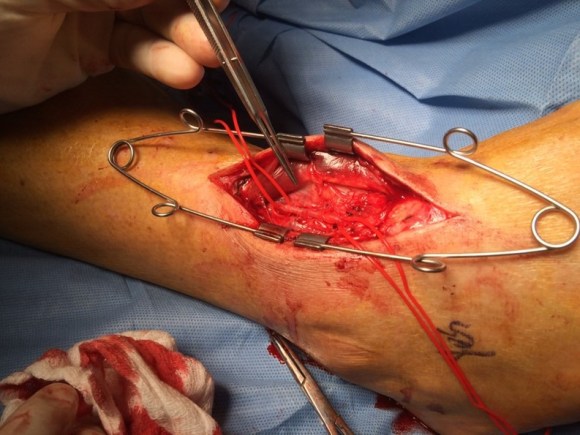
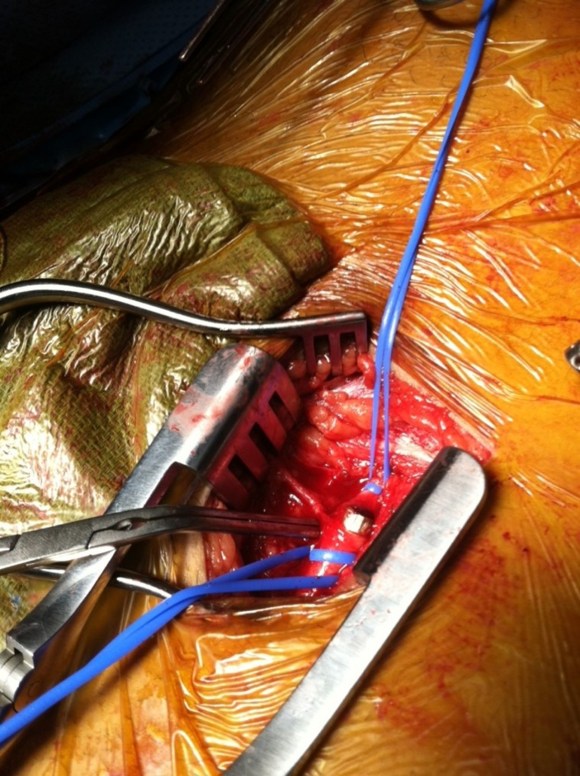
At time of resection, there were several geniculate collaterals that were actively feeding the aneurysm. These were ligated.These would be the sources of the endoleak.

figure 2

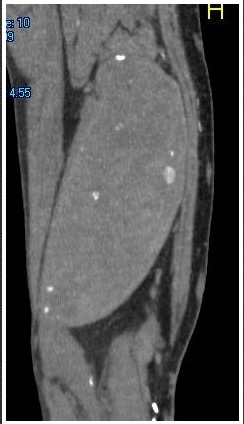
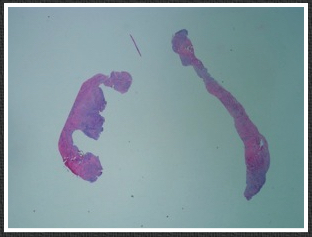
The specimen is below.

figure 3

In general, for larger aneurysms, simply ligating them prior to bypass may leave you susceptible to growth, and even after a rupture, an aneurysm like this can regrow to prodigious size from endoleak. Resection, partial or complete, at time of first repair addresses this potential problem, but was not possible at original operation due to blood loss and shock.

Categories
bypass PAD

Diastolic Pressure Traps and Valve Flutter in Reversed Vein Bypass Grafts

diastolic pressure trap 1

AUGUST 15, 2008 6:52 PM

The patient was originally bypassed for ischemic rest pain due to femoropoliteal occlusive disease. He had an occlusion of his popliteal artery with reconstitution of his below knee popliteal artery. I performed a femoro-posterior tibial artery bypass with reversed saphenous vein.

In followup, he developed at worsening stenosis in the distal graft at around 10 months post-op. Arteriography showed a moderate stenosis due to a valve that appeared to close. It was reported retained valve cusps which was strange because the vein was reversed. The flow was noted to be sluggish in the distal runoff, without a distal anastomotic stenosis. He was taken to the operating room, and this valve station was exposed and it had a severe stenosis due to valvular hypertrophy. This was repaired with patch angioplasty. At that time, I thought that this had developed due to a dynamic stenosis. No other stenoses were seen at that time.

In followup, after an initial period of two months without symptoms, the patient developed claudication that worsened. Graft duplex showed a severe stenosis in the mid graft. This was a valve station that was proximal to the previously treated valve station.

diastolic pressure trap 3

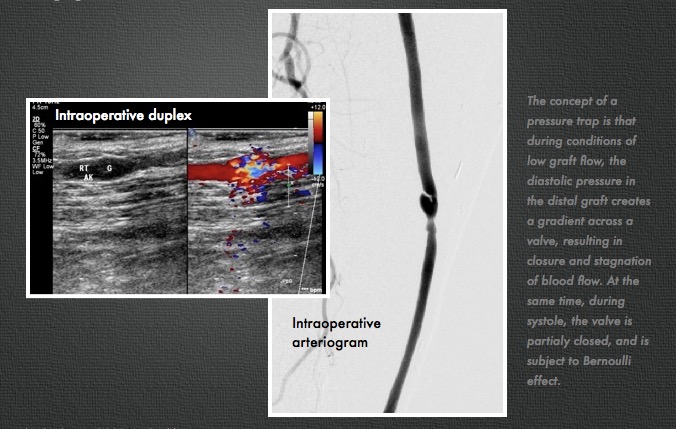
I took him to the operative endovascular suite, and arteriography showed a severe stenosis (image above, right) due to a hypertrophied valve. .

On review of the literature, I find that Tullis, Strandness et al. found 11 of 66 (17%) reversed saphenous vein bypass grafts had functional valves, with 50% of these developing  >50% stenosis, with a mean time to recognition being 10 months [ref 1]. In a followup study, Strandness’s group found that valve related revisions composed 16.7% of all graft revisions in reversed vein bypass grafts, while none of the revisions for in-situ grafts were valve related. No specific valve features, they concluded, could be identified as a high risk [ref 2].

Robiscek et al [ref 3] performed intraoperative flow studies and found that under conditions of low graft flow, pressure traps occurred in reversed vein grafts. When diastolic pressure in the vein segment distal to the valve is greater than the systemic diastolic pressure, the valve closes.

This patient does have sluggish outflow due to tibial arteries that are severely disease. I believe this causes a pressure trap, but I don’t believe it is a sufficient condition for development of valvular hypertropy resulting in a stenosis.

I think that a second factor is fluttering of the valves due to turbulence. The valve cusps are in a widened segment of vein, and there is naturally turbulence that occurs -this may cause the valve leaflet to flutter like a flag in a stiff wind and cause intimal hyperplasia.

diastolic pressure trap 2
Outflow disease causes valve closure in reversed vein bypass grafts. These valves are also susceptible to turbulent flow.

The concept of a pressure trap is that during conditions of low graft flow, the diastolic pressure in the distal graft creates a gradient across a valve, resulting in closure and stagnation of blood flow. At the same time, at the onset of systole, the valve is partialy closed, and is subject to Bernoulli effect.

This is supported by the pathology which shows hypertrophy of the resected valve cusps.
diastolic pressure trap 4

This model would predict another stenosis at a more proximal point at some later date if the patient has another valve station.

While I still reverse the vein when I bypass, I am cognizant of vessel sizes and won’t reverse if there is too great of a taper in the vein diameter. I also think that not reversing to diseased or single vessel tibial runoff may be a way of avoiding this problem.

References

1. J Vasc Surg 1997;25:522-7.

2. J Vasc Surg 2001;33:369-74

3. J Cardiovasc Surg 1999;40:683-9.

Categories
techniques

The 10 Minute Renal PTAS

renal stenosis 1

The trick to doing a 10 minute renal PTAS is all in the planning and visualization. Firstly, the CTA with 3D reconstruction (TeraRecon) gives excellent diagnostic images for arteries above 2mm in diameter and therefore obviates the need for additional diagnostic imaging if obtained before the planned intervention. The arteriography for the intervention then is focused on confirming the pathologic findings of the CTA. This patient has had prior lower extremity revascularization and has been troubled by difficult to control hypertension (4 meds) and mild renal insufficiency. Renal duplex found elevated velocities consistent with a >60% stenosis of his right renal artery. CTA revealed this, but also demonstrated a wealth of information regarding his aorta, his aorto-bifemoral graft,  an asymptomatic SMA stenosis. So my initial plan was given his hypertension was to perform a focused renal arteriogram and intervention with minimal time and contrast.

Planning

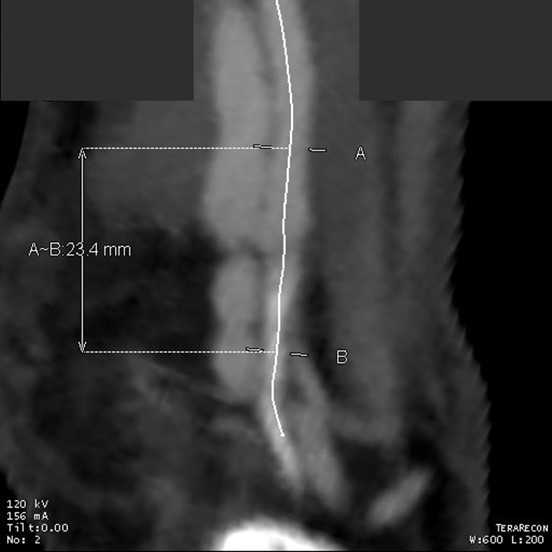
The first thing I did was go to TeraRecon and plan out access and camera angles. The CTA can show troublesome plaque, tortuosity, or lesions that could spell trouble for access. I decided to access the right hood of his aorto-bifemoral bypass graft above the anastomosis of his fem-pop bypass. Scar tissue, which can be problematic for sheath entry, can aid in excellent hemostasis. The camera angles and location of the renal arteries were determined with TeraRecon. I angled the view to see the right renal artery (above) at a orthogonal plane to my perspective -this turned out to be 20 degrees (see below). renal stenosis 2
Without TeraRecon, this is possible with axial views by creating a clockface and generating an “o’clock” with each hour being about 30 degrees (see above). The origin of the right renal artery is about 9:30 by this scheme. This give me the camera angle to find the renal without shooting an aortogram solely for the purpose of locating the renal artery. We already have an aortogram in the form of a CTA. The 3D reconstruction also informs us that the renal artery comes off at the base of the L2 spinal body at about 15 degrees LAO.

renal stenosis 3
This processed image from TeraRecon shows the skeletal landmarks where the origin of the RRA would be. The LIMA catheter is drawn on.
Access

I performed ultrasound guided access of the right femoral graft limb. Ultrasound allowed me to avoid the fem-pop graft. A micropuncture kit uses a small guage needle which is allows for repuncture. The sheath that comes with this comes with a stiff variant which goes through scar tissue well. I place a 6F sheath and send a wire into the aorta over which I send a 6F LIMA guiding catheter. This is actually a “cardiology style” of access, and the way coronary arteries are accessed. The guide catheters do need to be set up with Touhy-Borst connectors and 3 way stopcocks.

With the camera properly pre-angled, when the LIMA catheter comes in full profile, it should aim the tip at the angle of the takeoff of the renal artery. Using a 0.14 wire (Spartacor) in my case, I start probing with the wire tip at the base of L2 -another important piece of preplanning data. Usually, access to the renal artery is very straightforward at this point. The Spartacor wire has the backbone to support passage of stents and balloons. I use a 145cm length wire, and stents mounted on rapid exchange catheters. Renal arteriography is done through the LIMA catheter with hand injection, and intervention is very straightforward.

renal stenosis 4
The predeployment arteriogram shows the renal orifice to be smaller than the 6F LIMA guide catheter. After stenting, the artery no longer has a stricture at the origin.
The rapid exchange systems allow for quick catheter exchanges. Wires and catheters are removed. Total procedure times 10-15 minutes, and total contrast volume 10-20mL of contrast. This camera prepositioning, catheter profiling, spinal body aiming technique also works well in EVAR if you don’t have the 3D mapping package. Extra arteriography in localizing the renal orifices can often be avoided.
Categories
Journal Club

November Journal Club

OLYMPUS DIGITAL CAMERA

November Journal Club is going to be on November 11, 2014, at the Foundation House. The October session was well attended and excellent discussion was had on the INSTEAD-XL, EVAR-1, and 3 year duplex surveillance papers. David Hardy, MD, won the prize for best presentation, a fine text book from our sponsors, WL Gore. The papers to be discussed and discussants are listed below for the November Journal Club which will be earlier than usual because of the Thanksgiving holiday and the VEITH Symposium.

Deanna Nelson, MD – ACAS link

Roy Miler, MD –Carotid stenting versus redo CEA link

Daniel Lopez, MD –Contralateral occlusion impact on carotid interventions link

Our sponsor for that club is yet to be determined, but the club rules remain the same, particularly the 15 slide limit.


Categories
imaging TEVAR

Suprising result from gunshot wound to chest


bullet CTA


The patient was shot in the right shoulder and had walked to the emergency room with some dyspnea and back pain. CXR showed a right sided pneumothorax but no bullet. The paper clip on the 3D VR view of the CTA shown above is the entry wound. The green line traces the centerline of the aorta, aortic arch, and the right carotid system. The patient’s assailant was shooting from a balcony of a movie theater. Vascular surgery was consulted for loss of pulse in left leg during trauma workup.

CT scan of the chest and abdomen showed blood in the mediastinum and haze around the distal thoracic aorta.

Remarkably the patient remained stable. My plan was to cover the aortic perforation with a stent graft, but an appropriately sized graft for patient’s size was not available at that time in 2009, so we used a Zenith RENU cuff. The patient on examination had an absent left femoral pulse. I chose to explore this and use it as the access site of the TEVAR. I also made sure the detectives put on scrubs to receive the bullet as US laws about evidence requires witnessed removal and acceptance of criminal evidence.

The cutdown revealed the bullet (9mm round) to be lodged in the common femoral artery. It was placed in a kidney basin with a loud clank and handed off to the peace officer for processing.

The bullet managed to miss the esophagus, heart, major pulmonary vessels, upper abdominal organs, and gently nestled in the aorta and embolized to the femoral artery in the emergency room.

The RENU cuff’s delivery system was long enough –at the time of this procedure, smaller diameter thoracic stent grafts were not available and in the setting of trauma with younger patients, particularly female patients, this was a problem. An aortic cutdown was sometimes necessary to deliver a 24mm aortic cuff up near a tear due to deceleration at the ligamentum arteriosum of the pulmonary artery and aorta. The patient recovered well and this case report was written up by Dr. Jared Kray who is now a vascular surgery fellow in Missouri –the article is in print for the January issue of American Surgeon.

Categories
Commentary

Chronicle of the scientific efforts and human costs at the outset

A great New Yorker article relays the efforts scientific efforts focused on Ebola and the calculus of ZMapp allocation.

Link

Categories
random

A list of musings about Ebola from my notes

ebola

Link to Science article re genomics of current outbreak

I keep a small notebook around with me to jot phone numbers, clinical data, and random ideas. It is a kind of fossil of the pre-digital age that persists. When someone finds my box of these notebooks, they will think my life was consumed by frustrated novel writing, grocery lists of esoteric food items, and vascular ailments. They would be correct. Here are my top ten thoughts about Ebola.

  1.  Ebola is an RNA virus which likely has its origins in the most ancient recesses of life on earth. Likely during the prebiotic Hadean era, roughly a quarter billion years after earth solidified and liquid water started to coalesce into oceans, these molecules began replicating themselves within the primordial soup that made the whole planet a single cell, with chemical reaction times stretched over eons rather than seconds. When some of the molecules found shelter in enclosing the sea in a phospholipid bilayer, maybe some sudsy foam at the edge of an acid sea, these replicating molecules followed. The ribosome, transcription RNA, and other ribonucleotide based molecules in our cells are the friendly remnants of these molecules. Ebola is the stranger that comes to take life from our cells. Symptoms-Of-Ebola-1
  2.  This RNA world hypothesis is an idea first posited in the 80’s by Dr. Walter Gilbert, and RNA prefers an acidic, anaerobic environment, which is what is proffered once Ebola takes hold in the vasculature. The liver seems to be the place where Ebola’s fire ignites, and it offers the low oxygen, acidic environment that echoes the flavor of that primordial soup.
  3.  Edema due to vascular leak results in eventual dehydration, and more anaerobic, acidic environs to run in. Patients who are well hydrated and kept euvolemic seem to do better per reports on the web. To this, I would add well oxygenated which would become harder to achieve with third spacing into the lung. Is there a role for active alkalinization. Patient’s who have filled their lungs with fluid -is there a way to push forward development of an oxygenator that is inserted into the central veins.
  4.  Coherent light can cause particles of specific dimensions to resonate. Can this be a way of disrupting 80nm width virus particles? A light emitting catheter that uses laser energy to split virus particles while leaving other blood elements intact -for advance infections. Plasmonic resonance I believe it’s called.
  5.  The current movement of Ebola patients out of general hospitals puts into sharp relief the importance of training and will in controlling difficult medical problems and the role of specialty centers of excellence. Medecins Sans Frontieres are able to achieve in a rude tent in the fever jungle what country club hospitals cannot. Generations of domination over infectious diseases has bred complacency as few remember polio quarantines and no one remembers the Spanish Flu pandemic of 1918. At Columbia P&S, in the student lounge, there was a plaque dedicated to the 20 medical students who died while caring for victims of that pandemic that took millions of lives. At that time 20 years ago, dying from an infectious disease seemed quaint and atavistic, just bad luck like dying from a plane crash or shark attack. Now, we’re not so sure.
  6.  n=e^(qt) where q determines the rate of exponential growth. What is different about this outbreak compared to numerous others? The q may be different because of different factors but it starts with knowing the sequence of this Ebola compared to others. Also, the population density or temperature or inoculation may have been higher because of deforestation, climate change. Time will tell. The evidence thus far is that it is not airborne.
  7.  The thing not often talked about in the Irish Potato Famine is the poor potato. Crowded into unending fields of monoculture, often by cloning via sprouting the “eyes” of the potato, it left it vulnerable to the potato blight. We are an unending field of monocultured humans when we look at cities of 10, 20, 30 million pressed back to front. Typically, human overpopulation is seen to be treatable through some combination of education, development, and draconian laws, because it is in our nature to be fruitful and multiply. Even plagues and wars fail to remove our reproductive drive. I feel least optimistic about this, and feel fraternity with the Irish Potato.
  8.  Soap and water. Alkalinizing and oxidizing. Bleach. Peroxide. Alcohol? How do you kill something that is lifeless? We will be dealing with this for a long time but it won’t be like HIV. I have been stuck with needles from HIV+ patients and lived, and my biggest immediate fear then, even 10 years ago, was hepatitis, not HIV. This different.
  9. Hackathons solve some hefty problems related to data security. We don’t have hackathons for these kind of medical and scientific problems. All the scientific disciplines have specialized to the point that its rare for people of different disciplines to synthesize and collaborate. I have socialize regularly with a physicist and live across the street from virologists. I had half a mind to bring them all together, and my physicist friend had the same thought. He works on plasmonic resonance -I won’t get into the math but at the size of nanoparticles, which are the size of Ebola virions, things resonate when hit with a particular frequency of light resulting in chemical changes. The problem is its too dangerous to work with Ebola directly, but the principles of phototherapy for example could be worked out in a model using plant RNA viruses -and we have a world leading lab here in Cleveland. Every university town in fact has the human capital to do something, but the way we have structured science and discovery works against multidisciplinary work. There should be a Cleveland Project, a Boston Project, a Berkeley Project, an Austin Project and so on. Let the hackathons begin.
  10.  We survive as communities. The biggest lesson Zombie movies have for us is that the real monster is the unfriendly human. The other hidden lesson is that going it alone is unwise. We are evolved as social animals that hunt in packs and keep secure in numbers. That means we need each other more than ever before.
Categories
Uncategorized

Using a shunt to control an artery stuck in scar tissue

IMG_2461.JPG

The usual situation is a multiple redo or infected groin with heavy scarring. Woody is the proper adjective. The common femoral artery may be obliterated or buried in the scar but a small profunda or its major branch may be accessible. Or you just run into it and get bleeding. Rather than bemoan your fate, you may be able to make a purse out of sow’s ear by exposing the artery and sliding in an appropriately sized Argyll shunt. Backbleeding into the shunt means that you haven’t dissected (hopefully) the artery, and now you have control over the surface edge of an artery. You can then clamp the shunt. You can assess your situation and decide that spending another two hours digging out two centimeters of 3mm artery may not be worthwhile, but you also decide that it is important to preserve this vessel.

It is straightforward to anastomose graft to the arterial stump. The shunt keeps you from narrowing the anastomosis, as you are well aware from carotid shunting. While you are doing this, if you have a Rummel tourniquet or vessel loop around the distal external iliac, you can feed the leg via this shunt as long as you remember to have the graft over the shunt. And remove it when you are done.

Another scenario is in revascularizing an intercostal, lumbar artery, or backbleeding posterior origin accessor renal but don’t want to do it right away.

shunt

Categories
training

4 Questions for Trainees Before An Operation.


  1. What are the indications for surgery?
  2. What kind of operation are you planning with what approach?
  3. If different (open, endovascular, or hybrid) approach is preferred by you, please briefly elaborate. If not, explain why?
  4. What are the anticipated risks, recovery, and followup?

I started having my trainees (yes, you) email me answers to these questions for an upcoming case and it has been working pretty well. This starts a conversation. This exercise gives the trainee time to think about their plan, do some reading, ask questions, and anticipate outcomes so that an unexpected one would be rare. It also gives me a record of a meaningful interaction so that later assessments don’t devolve into flash judgment, gut feeling, first impressions, or recall of latest misdemeanors.

Not infrequently, I have trainees whose opinions differ from mine, but they base their arguments on solid evidence and clinical findings specific to the patient and not just the general topic. They express a nuanced understanding of that particular case and bring in fresh perspectives from their diverse backgrounds and education. I think to myself how honored I am to have such hard working, brilliant minds to teach; I make sure to tell them how absolutely wrong they are.

Categories
Uncategorized

All Those IVC Filters

Thousands of filters were placed over the past decade and the cows are coming home to roost. My feeling is that if a removable filter goes in, there must be an appointment or mechanisms in place to arrange for it to come out, anticoagulation must be started as soon as feasible, and kept on as long as possible if the filter is to remain in. Failure is infrequent for the conical designs, and not an issue if the filter is removed. How long after implant that a filter can be removed seems to be a moving target. In my personal experience, I have safely removed them out to two years, but I have partners who have gone beyond that by multiples. Two rare late failure modes of IVC filters can be devastating and life threatening.

IVC Perforation

This patient developed a vague upper abdominal pain and plain radiography showed the filter on a tilt. CT shows the legs of this Simon Nitinol filter extending into the right kidney and duodenum.

The 3 D VR images assisted in operative planning –as is my habit, it rotate the image into the surgeons-eye perspective to plan the incision.

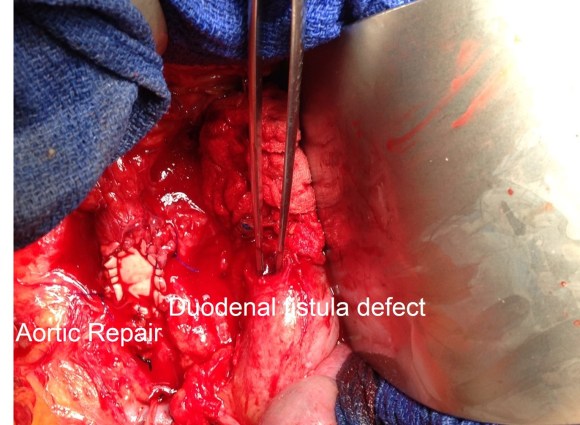
The green arrows point to the exposed legs of the filter once the right colon and duodenum were rotated out of the way. The duodenum required only a serosal suture. The vena cava above and below the filter and both renal veins had to be controlled to remove the filter which was extirpated in pieces. I have had to do this about once a year or two. The youngest patient I operated on was a 20 year old who had a filter placed after a car accident at 17, but never had it removed. The legs of the filter had eroded into his duodenum causing an abscess.

Iliocaval Thrombosis

The figure below shows two panels with a Trapease filter associated with an iliocaval thrombosis. This patient had cardiovascular collapse and severe bilateral lower extremity edema after a long car ride.

Venography showed iliocaval thrombosis. Thrombolysis was started and the second panel on right of Figure 1 shows the result.

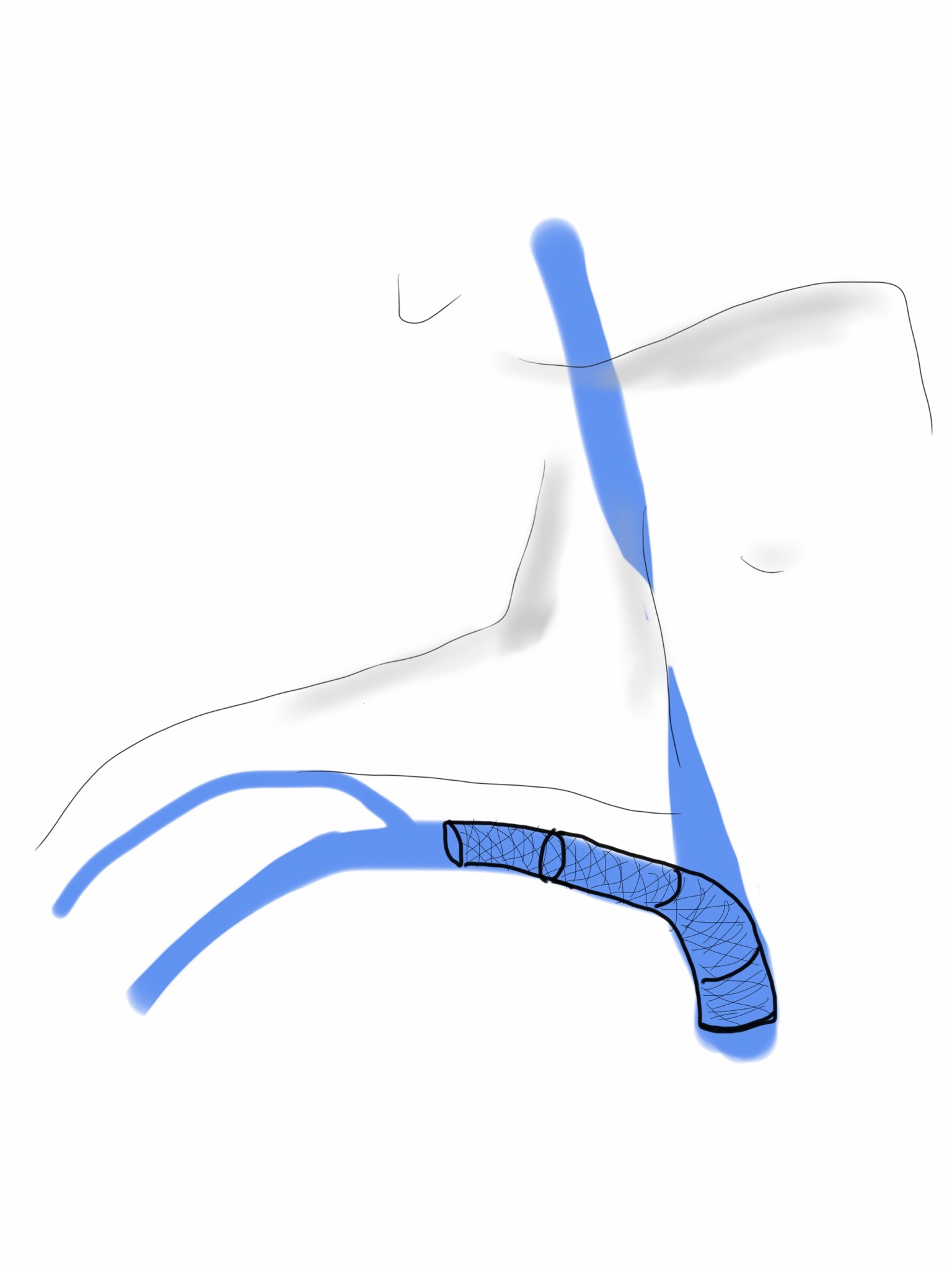
Large WallStents were used to support the recanalized iliocaval system from the common femoral veins to the filter. A Palmaz stent was deployed across the filter (Figure 2).

Figure 3 shows the final result. Interestingly, stents placed across the inguinal ligament into the common femoral vein seem to do fine in contrast to those placed in the artery. IVUS is necessary to confirm good results. Acceptable short term, and durable mid to long term results are reported.

Remove Them While You Can

Filters should be considered a short term therapy to decrease the risk of pulmonary embolism, and should be removed as soon as it is safe. There seems to be no magic time interval beyond which removal cannot be attempted. If permanent filter placement is planned, it should only be for established indications.